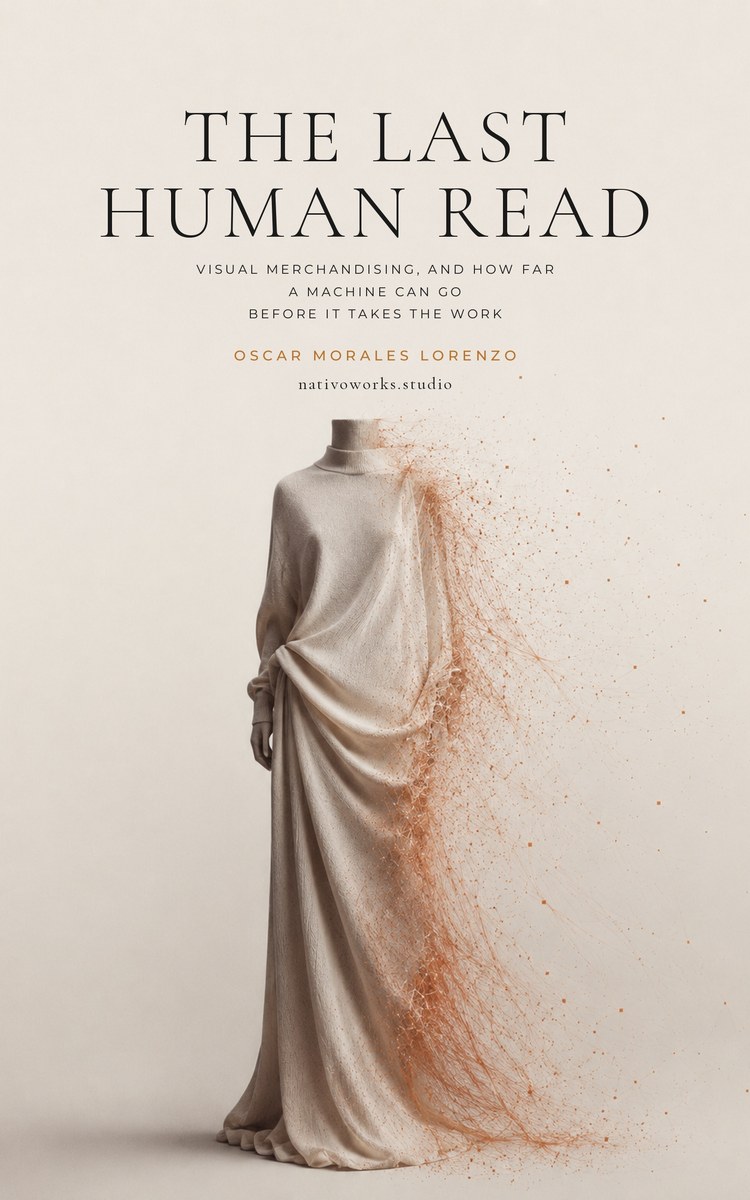
The Last Human Read
Visual Merchandising, and How Far a Machine Can Go Before It Takes the Work
Give a machine every number a store has — sell-through, foot traffic, the customer data — and it knows what the visual merchandiser knows. The information was never the advantage.
The advantage is the read: the judgment made from hours in the store, the shadow a render couldn't show, the thing a merchant means and doesn't say. This book hands that read to a machine, trial by trial, and reports where it kept up and where it stopped.
It was written with the machine it tests. That is not a confession. It is the method, and the book is its own evidence.
The machine computes the light to a fraction of a degree, drafts in an afternoon what took weeks, reconciles a global brief in seconds — and stops at the same place every time. It reaches the measurement and not the meaning.
The read holds because a person keeps doing it. That it rests on a choice is the finding, not a weakness in it.
A memory can be built for a machine — in plain files, with the reasons attached — and it is the new craft.
The title is left open on purpose. The answer belongs to the people who do the work.
Visual merchandisers, store designers, and retail creative leads who are already working beside these tools and want an honest account of where the edge is this year — from someone inside the craft, not a technology writer. Ten chapters, an appendix for running your own trial, a few hours' read.
Read the whole book.
Ten chapters and the appendix for running your own trial — as a PDF and an EPUB. Leave your email and tell me where you work it. That is the price.
Oscar Morales Lorenzo is a visual merchandising leader with fourteen years in global retail, and the founder of nativoworks.studio. → About
Also in Castilian Spanish: La última mirada humana →